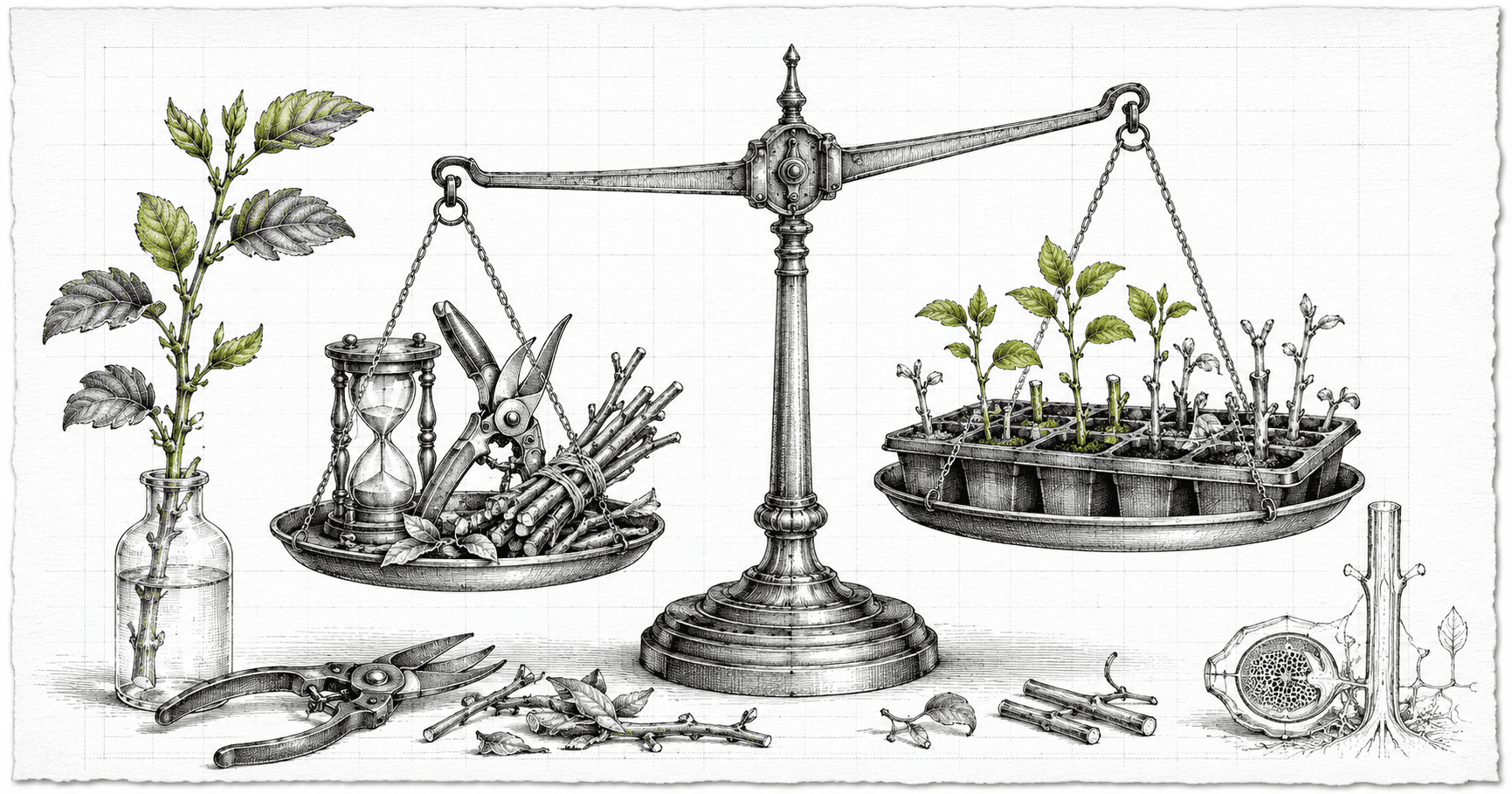
Content amplification ROI in 2026 is no longer just a time-savings calculation. Manual repurposing of one long-form piece into platform-native posts takes 5-8 hours; AI-assisted amplification cuts it to roughly 45-60 minutes. The harder question is whether the hours you save produce output the platforms still distribute — because templated AI content now loses measurable reach.
So the answer to "how much time does content repurposing save" is straightforward on its own; the answer to "is it worth the cost" requires a third line item most ROI guides skip. This is the calibrated version of the math, with the saved-hours number, the freelance-rate breakeven, and the algorithmic-cost correction the 2026 environment makes mandatory.
How Many Hours Does Manual Content Repurposing Actually Take?
Manual repurposing of one long-form source — a 1,500-2,500-word blog, a 60-minute podcast, a webinar — into platform-native posts for LinkedIn, X, and Instagram runs between 5 and 8 hours per source piece, depending on input modality and creator skill.
The number triangulates cleanly across 2026 vendor and practitioner studies. Peppereffect's task-by-task table for a 60-minute video into 10 derivative assets puts manual time at 180-240 minutes plus another two-to-three hours of copywriting and scheduling. InfluenceFlow's 2026 guide lands at 4-6 hours of adaptation time on a 2,000-word blog into 10 posts plus an email and a video script. An independent creator on Open Forem documented their own workflow at 2 hours to turn one blog into 15 assets, with the honest caveat that creating those 15 assets from scratch — not from a single source — would have taken 30-40 hours.
The shape of the work is consistent: about an hour scrubbing the source for shareable moments, an hour or two extracting and resizing clips or quotes, an hour rewriting captions for each platform's culture, and a final half-hour scheduling across native interfaces. Multiply by weekly cadence and most creators are looking at 20-32 hours per month dedicated entirely to reformatting work they've already done once.
For a busy founder this is the line item that's actually expensive. One r/ContentCreation post in our customer corpus says it plainly: "I create one video weekly and need to repurpose into 20+ social media posts across platforms. Currently doing manually which takes 5+ hours weekly and I'm dying."
How Much Time Do AI Amplification Tools Save?
AI-powered content amplification tools reduce the same 5-8-hour manual workflow to roughly 45-60 minutes including a human review pass, which is the 70-80% efficiency band that holds up across multiple 2026 measurements rather than the inflated 95-97% headline figures.
OpusClip's own ROI of repurposing analysis puts manual editing of one 30-minute video into 10 clips at 4-6 hours at $50/hour — $200-$300 in labor per source — versus 30-60 minutes of review with an AI tool, total monthly cost of $130 against $800-$1,200 manual. Peppereffect's breakdown lands in the same range: full repurposing of one video into 10 assets drops from 180-240 minutes to 45-60 minutes, a 70-80% reduction. Founder-survey data from Monolit's 2026 review reports 8-12 hours per week reclaimed by creators who moved to AI-native repurposing.
The credible skeptic here is Refact's 2026 workflow analysis, which warns that vendor numbers are "directional, not guaranteed" — Orbit Media and HubSpot syntheses put average efficiency gains across broad content operations closer to 10%, with the 50-70% gains concentrated in narrow, repeated workflows. The sweet spot is real but workflow-specific. AI does not save time on the parts that needed your judgment; it saves time on the reformatting, transcription, and platform-shaping middle steps.
For Sembra specifically, the comparable benchmark is what I documented in how many social posts you can get from one blog — a 2,400-word blog through the pipeline produces 24 distinct posts plus 42 hook variations in under two minutes. The 24 sits at the calibrated distinct-angle ceiling of a rich source; the hooks are intra-angle variations for A/B testing, not 42 more posts. Add human review and the practical end-to-end time is roughly 30-45 minutes per source, which is the band I'd defend as honest.
Is Content Amplification Worth the Cost? The Breakeven Math
The breakeven on a $19-$30 monthly AI amplification subscription is a single reclaimed hour at any defensible 2026 freelance rate. The economics genuinely do not need a calculator.
The 2026 freelance social-media-manager rate is convergent across five rate guides: SolidGigs reports $20-$35 beginner, $35-$75 mid-level, $75-$150 expert; goLance puts the mid-level average near $60/hour and senior practitioners at $80-$140. Sprout Social cites a $20-$150 hourly range. Apaya prices founder-time opportunity cost at "$75/hour conservative" — at 10-15 hours per week of DIY content work, that's $4,500-$6,000 per month hidden inside the founder's calendar.
For concrete tool reference points, narrativee runs $19.99-$25.99 monthly, Opus Clip Starter is $15 and Pro is $29, Blotato Starter is $29, SocialBee starts at $29, and Hootsuite's Standard tier is $99 annually. At a $60/hour mid-level rate, even the most expensive small-business AI tool pays for itself in roughly 30 minutes of reclaimed work per month. The math is so favorable that the only honest reason to skip the tool is that you don't ship the long-form content in the first place — amplification with no source piece to amplify is a non-starter.
The upside, not just the cost side, is also worth pricing in. Buffer's Creator Growth Playbook — analyzing roughly 100,000 users and around 2 million posts — found that creators posting in 20 or more weeks out of 26 saw approximately 450% more engagement per post than those posting in 4 weeks or fewer. The hours you save are the hours that make the cadence the algorithm rewards actually possible, which is the deeper case I made in social media consistency vs quality.
The Line Item Most ROI Guides Skip: Algorithmic Cost in 2026
Here is the third line item that turns a clean ROI calculation upside down in 2026: templated AI output now loses measurable reach, and the gross hours saved have to be discounted by the percentage of distribution the saved-hours posts forfeit.
The numbers are convergent enough to take seriously. The Originality.ai 8,795-post study surfaced in Syxo AI's 2026 synthesis measured a 45% engagement gap between likely-AI and likely-human LinkedIn long-form posts; accounts publishing more than 70% AI content saw a 34% impressions drop, while accounts under 30% AI usage saw a 22% impressions lift. The March 2026 Authenticity Update classifiers, sitting on top of LinkedIn's 360Brew foundation model, are associated with roughly 30% less reach and 55% less engagement for AI-detected posts. DigitalApplied's cross-platform analysis pegs the average engagement penalty for identifiably AI-generated content at 12% across major platforms — with a corresponding 9% lift for AI-augmented content that includes human editing.
The structural finding from the same body of work is that hybrid AI — AI draft plus human edits plus personal details — performs on par with fully human-written posts. It is not "AI versus human." It is "templated versus voice-aligned." The "one-prompt repurposing" Claude and ChatGPT templates propagating across X right now sit on the templated side of that line by construction; a single prompt asking for 20 posts mode-collapses into paraphrases of the strongest theme. You save the 5-7 hours and lose 30-45% of the reach those posts would have had if they read as yours. That is not zero ROI — it is materially worse ROI than the spreadsheet shows, because the spreadsheet was missing the third term.
The honest 2026 ROI equation looks closer to this: (hours saved × your effective hourly rate) + (consistency upside) − (algorithmic penalty × % templated output) − (tool cost). The first three terms move in your favor only when the saved-hours output still reads as you wrote it.
What I Learned Building This
The architectural answer to the algorithmic-cost problem — the part I genuinely had to build to understand — is that how an AI tool prompts itself matters as much as the model behind it. I documented this in the AI purpose gap post: one structural change to how Sembra frames purpose context inside the prompt lifted brand-voice instruction compliance from 24% to 83% — a 53-percentage-point jump, 3.5× improvement, same model, same examples, only the framing changed. Most one-prompt repurposing templates ship the 24% version.
That finding is the line that connects the ROI math to the engineering. A tool's headline savings number is whatever it claims; the question that decides whether those hours produce returns is whether the output sits on the rewarded side of the 360Brew Authenticity Update filter. Two structural decisions inside Sembra do most of that work: a relationship-mapping stage that enumerates distinct theme-to-quote-to-hook combinations before generation (the $0.02 decision I wrote about in why I'm building Sembra), and full-corpus brand-voice modeling using Hyland's metadiscourse framework rather than a casual / professional / witty tone dropdown. The first decision is why a 2,400-word blog produces 24 distinct angles instead of 24 reformulations of the introduction. The second is why the output reads as the creator wrote it instead of as the model defaulted to.
Neither of those is exotic engineering. They are the line items the listicle cohort cannot measure because they do not exist as features in tools that ship the 24% version. That is the actual moat, and it is also the actual ROI variable.
So What Should You Actually Do With This
The practical version is worth sitting with. Track your manual repurposing time honestly for one week — almost everyone underestimates it. Multiply by a defensible hourly rate from the range above (use $60-$75 if you're solo). Compare to the $20-$30 tool tier — if you ship one long-form piece per week, breakeven is the first hour, and the cadence upside compounds on top.
The part the saved-hours math doesn't show: pick a tool that preserves the angle variety and voice fidelity of your source, not just one that fires posts faster. Test by feeding it one of your strongest existing posts and reading the output blind. If a colleague who knows your writing can't tell which posts are yours, the algorithmic-cost line item is already working in your favor. If the output reads as generic, you are saving hours and losing reach.
This is the calibrated read on content amplification ROI in 2026: amplification is worth the cost precisely when the saved hours produce posts that still distribute. Sembra is built for the second clause — 15-25 distinct, platform-native posts from one long-form source, in your voice, with the relationship mapping and purpose framing the algorithm now requires. The fastest way to test the ROI math against your own content is to run one of your existing posts through it. Visit sembra.ai for the current state of plans during the launch window.