Social media algorithms reward consistency as a precondition for distribution, but they do not reward it over quality — the 2026 data shows quality and topical relevance determine how far a post travels, while consistency mostly determines whether it gets tested at all. The "social media consistency vs quality" framing is the wrong question. The real constraint is supply.
That distinction matters because most advice collapses into "just post more, just be consistent" without explaining how anyone with a full-time job sustains that. This post is for creators, founders, and small marketing teams who already produce good long-form work but watch their social presence stall the moment cadence slips. I'll walk through what LinkedIn, X, and Instagram algorithms actually reward in 2026, why the consistency-quality debate is misframed, and what I learned running Sembra's own building-in-public presence.
Do social media algorithms actually reward consistency over quality?
They reward consistency as a gate and quality as the amplifier — not one over the other. Consistent posting is what gets your content into the algorithm's test pool; quality is what decides whether it scales beyond that pool.
The strongest evidence comes from Buffer's analysis of more than 100,000 users across 10 platforms over a 26-week window. Accounts that posted in 20 or more of those weeks ("highly consistent") earned 450% more engagement per post than sporadic posters who managed four weeks or fewer. Even moderately consistent accounts — active in 5 to 19 weeks — saw 340% more engagement per post. That is not a rounding error; it is the difference between a presence that compounds and one that flatlines.
But the same study found the gains are not infinite. Engagement per post peaked around 21 active weeks and then plateaued and gradually declined. Consistency clears a bar; it does not keep paying you for grinding harder forever.
How often should I post on social media for best results?
The 2026 benchmarks converge on a moderate, sustainable cadence: roughly 2-5 posts per week on LinkedIn, 3-5 per week on Instagram, and 3-4 per day on X. There is no universal number, but every credible dataset agrees the biggest gain comes from moving off near-zero, not from maxing out volume.
Buffer's study of over 2 million LinkedIn posts across 94,000+ accounts, using fixed-effects regression to isolate frequency from account size, found that moving from one post per week to 2-5 adds about 1,182 impressions per post. Pushing to 6-10 adds ~5,001; 11+ adds ~16,946. Real gains — but Buffer's own caveat is the load-bearing sentence: "Low-quality content posted frequently won't yield great results." The lift assumes the quality holds, and at high cadence it rarely does.
Going the other direction is worse. Buffer's cross-platform work identified a "no-post penalty": weeks with zero posts consistently underperformed an account's own baseline growth. On X, where most engagement happens in the first 15-30 minutes and the open-sourced algorithm weights replies far above likes, long gaps can reset your algorithmic standing entirely.
Why is the consistency-vs-quality debate the wrong question?
Because consistency and quality are not on the same axis, and treating them as a tradeoff hides the variable that actually constrains both: supply. You only have to choose between them when you have run out of things worth posting.
Watch what the algorithms reward and the picture sharpens. LinkedIn moved from a connection graph to an interest graph powered by LLM-based ranking — its 360Brew foundation model and Generative Recommender now drive distribution by topic authority and dwell time, with only about 31% of the average feed coming from first-degree connections. Daily posting on LinkedIn is associated with roughly a 26% drop in average reach per post, because the extra posts dilute topic clarity rather than reinforce it. Instagram's 2026 ranking leans on watch time, likes-per-reach, and DM shares; Metricool found Reels posting frequency rose 35% year over year while reach per post fell 31% — pure saturation. X rewards posts that spark genuine reply threads, not posts that merely exist.
Every major platform in 2026 has structurally capped the payoff of volume and raised the payoff of depth, topical coherence, and authenticity. That is the opposite of "post more, win more."
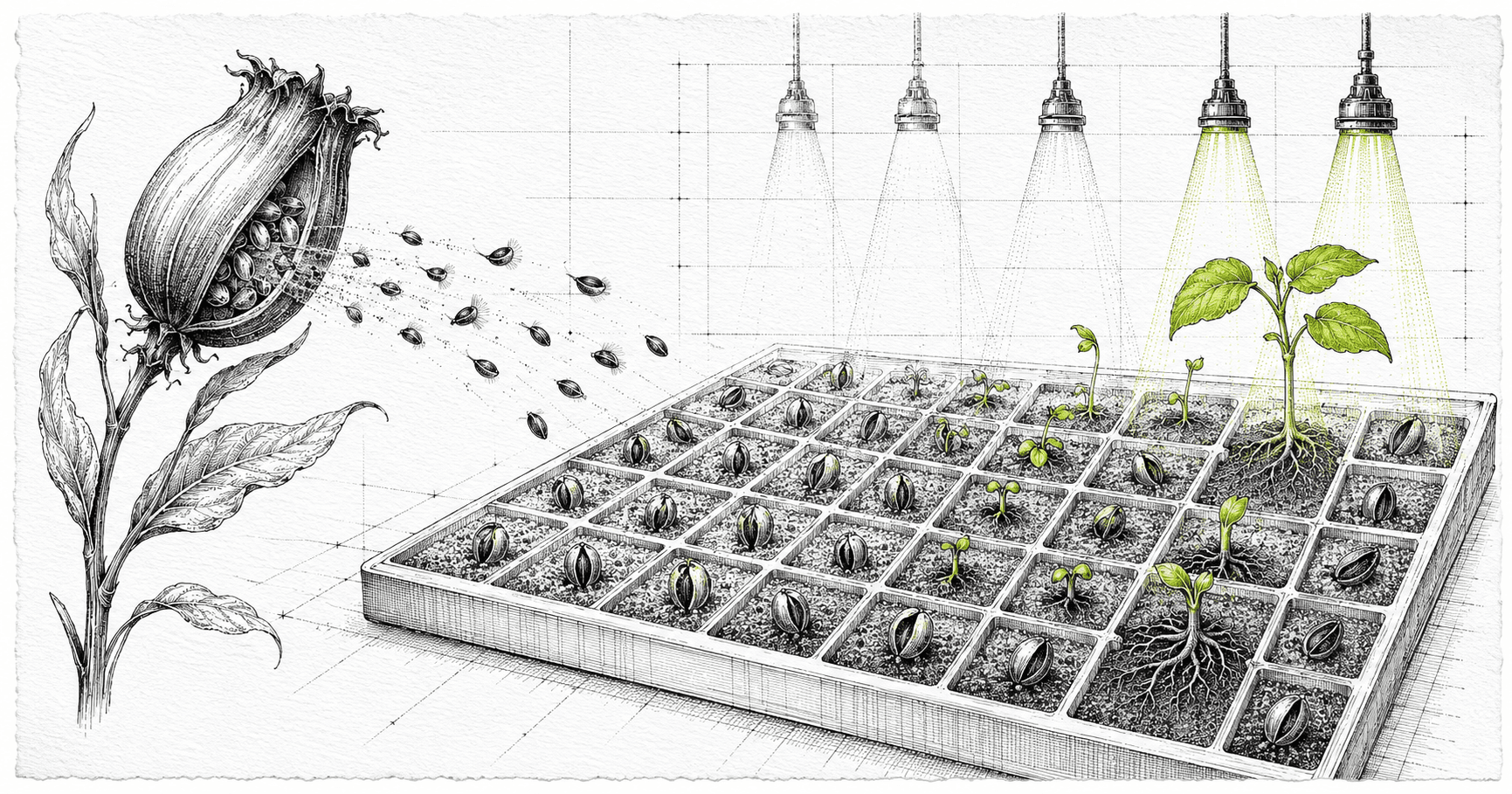
So the operative question is not "should I prioritize consistency or quality?" It is: do you have enough genuinely good, platform-native content to be consistent without each post getting worse? When supply is short, you either lower quality to hit cadence — and the algorithm punishes that — or you skip, and eat the no-post penalty. Both failure modes trace back to one shortage.
What I learned running Sembra's posting cadence
When I pushed Sembra's building-in-public presence from roughly two posts a week to around five, I expected the hard part to be discipline. It was not. I had a calendar. I had reminders. What I did not have was enough things worth saying that were already shaped for each platform.
The bottleneck was never motivation or a scheduling tool — it was supply. By Thursday I had usually said the thing I actually had to say, and the choice in front of me was post something thinner or post nothing. That is the exact moment the consistency-vs-quality tradeoff appears: not as a philosophy, but as a Thursday-afternoon supply shortage. Every creator I've talked to who "fell off" describes the same week.
This is the problem I built Sembra to remove. One piece of long-form work — a blog post, a newsletter, a recorded talk — does not contain one social post. It contains 15 to 25, each a different angle, each formatted natively for its platform rather than the same paragraph pasted five times. (I broke down the actual math in how many social posts you can get from one blog post.) When the source is good and the supply is deep, consistency stops being a willpower problem because you are no longer choosing between cadence and quality on a Thursday. Scheduling for LinkedIn and X is built in, so the same long-form source flows from generation through to publish without a second tool in the middle — the supply constraint and the cadence constraint, removed together.
Topic authority makes this sharper. LinkedIn's interest graph rewards posting consistently about a coherent subject, not just posting consistently. Amplifying from focused long-form work keeps every post anchored to the same topical fingerprint — which is structurally what the 2026 algorithm wants — instead of scattering ad hoc takes that dilute it.
How small teams should actually think about cadence
Pick the highest cadence you can sustain without quality dropping, then solve the supply side so that cadence is higher than you'd guess. The benchmarks are a floor to clear, not a target to max out — Buffer's data is explicit that the right number is "the number you can stick to."
A few things worth sitting with. First, consistency is a precondition, not a strategy — clearing the no-post penalty gets you into the game; it does not win it. Second, the industry has already moved: 83% of B2C marketers say quality trumps quantity even when that means posting less, and average brand posting volume has fallen even as engagement has risen. Third, the lever most teams reach for — a scheduler — solves distribution, not supply. A scheduler with an empty queue is just a calendar reminding you that you have nothing to post.
The durable fix is treating every piece of long-form work as a content reserve rather than a single post. That's the core argument of our complete content amplification guide, and it is why I think the consistency conversation has been stuck: people keep optimizing the publishing step when the shortage is upstream.
The real takeaway: solve supply, and consistency stops being a tradeoff
Algorithms in 2026 reward showing up regularly and showing up well — they have made it structurally impossible to win by doing only one. The teams that sustain both are not more disciplined; they have removed the supply shortage that forces the choice in the first place. Figure out where your long-form work is quietly sitting undistributed, and you'll usually find weeks of platform-native content you already paid to create. That's the problem Sembra exists to solve — turn one good source into a consistent, high-quality presence, without choosing between the two.